
 Coral
Coral
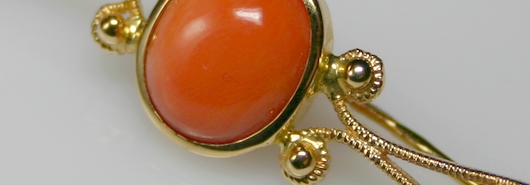
The Coral – Jewel Of The Seas
Corals, along with the precious stones and pearls, are very important in the world of jewellery. Products made of coral ornaments are attractive both in Europe and the East - especially in Japan.
Corals are organic. These are the skeletons of calcareous corals (Anthozoa), belonging to the lower marine organisms. The trunks of coral colonies reach an average of 40 cm, branches up to 4-6 cm thick. For the ornamental purposes the most valued is the precious coral, which due to the vivid, red colour was named the red coral or the real coral. There are also black, white, pink, and other varieties.
Precious Corals form colonies at depths of 3 to 50 meters. The most species live in the Mediterranean Sea off the coast of Algeria and Tunisia, western Italy (Calabria), Corsica, Sicily, Sardinia and the Aeolian Islands. They grow also in the Bay of Biscay, near Madeira, the Canary Islands, the Malay Archipelago and along the south-western coast of Japan. In Italy, the number one species that have well-shaped skeletons is named the Capo Testa, another kind with thinner skeletons with branch splinters - Barbaresco, the third, with thin branches - Terraglia, and the fourth – coral debris - Raspatelli. Also highly valued are the Algerian corals, which produce the least waste from the treatment. The Sardinian and Dalmatian corals have beautiful, vibrant colours, same as Dalmatian - very rare, not common on the market . The Japanese corals are bigger and thicker than Italian.
The black coral comes from the black skeleton species, related to the precious coral, but with a horny skeleton. Tree-like or fan-like black coral colonies can get up to 3 meters in height and the trunks reach 20 – 35 cm thick. They occur mostly around Malay Archipelago, by the west coast of India and in the Red Sea.
In the subtropical countries the Akori coral can be found – a very high valued, red, violet and blue coloured. They are formed of porous aragonite skeletons of marine hydrozoa called coral though they don’t belong to the coral group. Akori occur near the western shores of Africa and close to Samoa island.
Coral ornamentation reaches old times. The earliest evidence lead us to the excavations of the Bronze Age, among which coral decorated items were found. In Europe, coral usage started no sooner then in the XVth Century. Up to French Revolution, the monopoly for coral belonged to France and then to Italy. A big role in shaping the "coral fashion" have been played by the influential European courts. The Empress Josephine’s - Napoleon's wife love for jewellery was legendary, and coral was one of her favourite stones. She wore it with pleasure, and often gave coral ornaments as a gift. Coral played a role of an amulet and talisman for a very long time. They were supposed to protect from disease and danger. This belief has survived until our times. The precious varieties of coral serve as material for a variety objects, such as combs - one of the designs was named after the Empress Josephine - hair pins, etc. When matching coral with precious stones or gold, we achieve beautiful decorative effects. There are also cameos and sculptures made of larger pieces of coral or combinations of different coral colours and types.
Coral embellish rings, brooches, earrings and pendants, but the most common is the coral necklace. In Poland, such a necklace is an inseparable piece of Cracowian regional dress. It is inherited in the family as precious family jewellery.